0:00 Nicholas Olsen after that session, the agent came upstairs, into the room and goes, Look, the the coach wants to see you for another day. And I was like, really? He wants to see me for another day? And he's Yeah, he wants to see you for another day. I like, whatever, man, it what it I'm here now. Let's do it. Goes out of the room five minutes later, comes back in the room and goes, we actually haven't got time. The window's closing soon, so we gotta go and sign you.
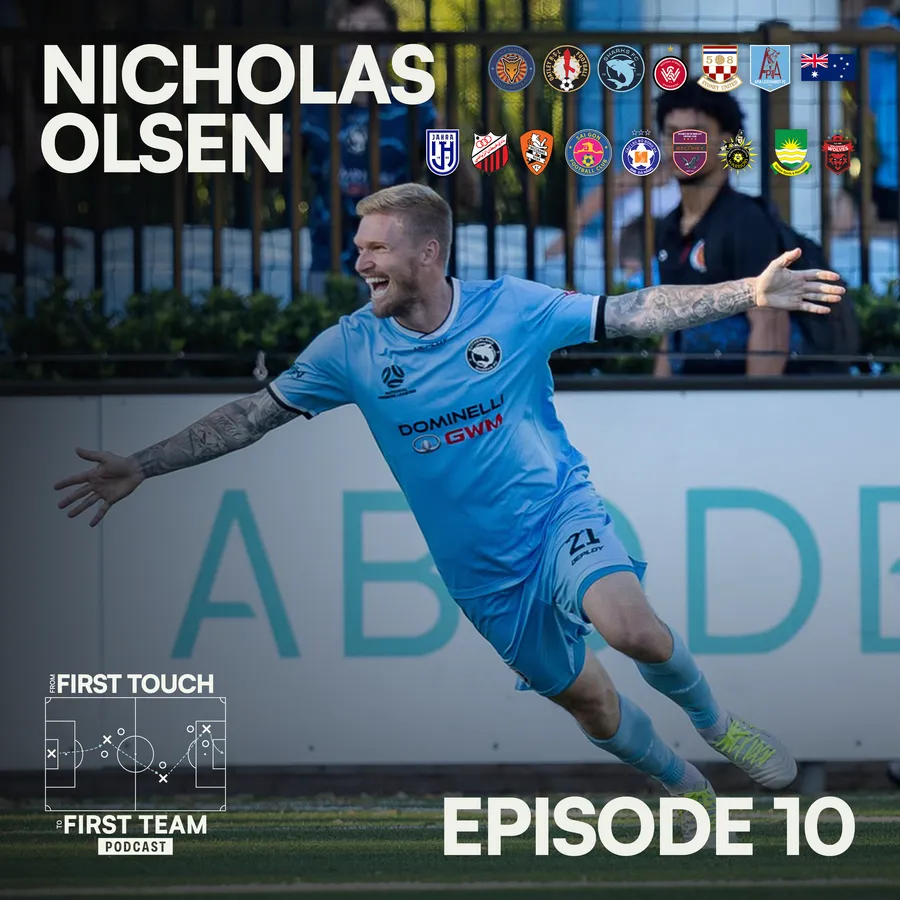
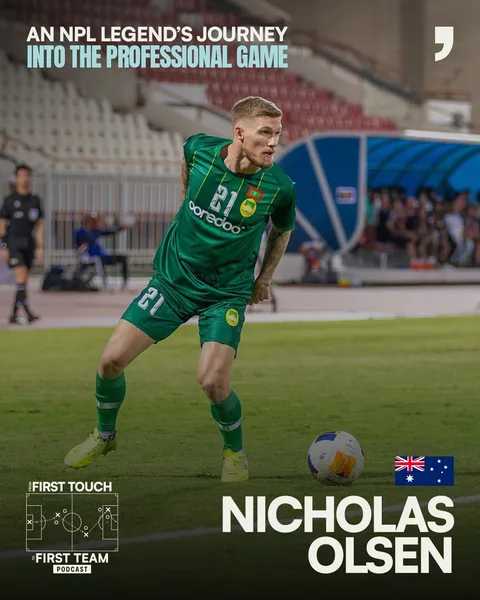
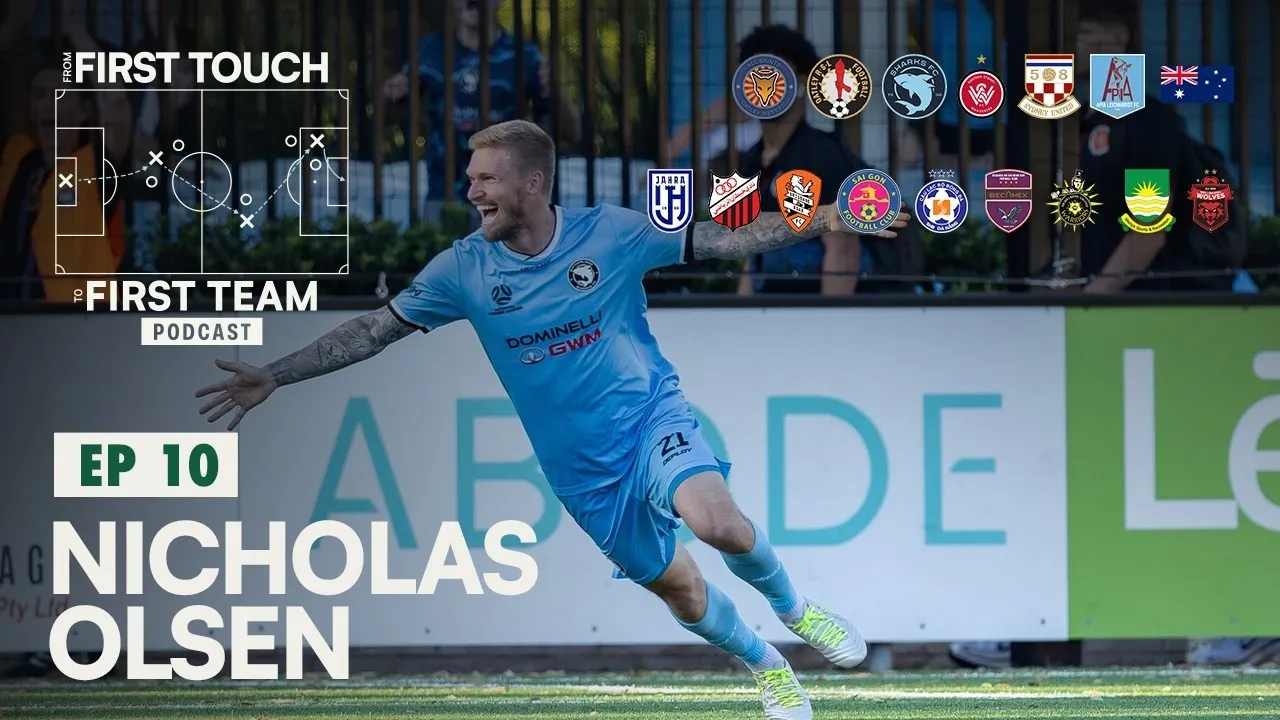
0:20 Jan Welcome back to From First Touch to First Team. I'm Jan, your host, and for our 10th episode, I'm sitting down with Nicholas Olsen, who grew up in Sydney, never took the traditional academy route, and built a professional career that took him to Kuwait, Vietnam, the Maldives and beyond. In this episode we get into what it actually looks like to chase a professional career through countries most people will probably never associate with the professional game. Why the path to become a professional footballer does not always look glamorous. And what every young Australian player needs to understand about persistence before they give up on their dream. As it's already our tenth episode, I would like to say thank you for everyone who's been supporting us, listening and subscribing and interacting with our social channels. We have many, many more guests in the pipeline. We're gonna work on a few special episodes. And at this stage, ten episodes in, I wanna say a big thank you to Neongoat who's been supporting us and providing our giveaways. Nardo who's now coming on as one of our partners, And as usual, I want to remind you that every episode on this show is a conversation that a young player or football parent somewhere needs to hear. If you know someone on their journey, please pass this on. Subscribe, share it, and help us keep building something that generally helps everyone. And if you have a question, a comment or something you won't cover in a future episode, drop it in the comments on Spotify, YouTube, leave us a review or send us a message on Instagram. We're gonna read for everything and we really appreciate your support and your feedback. And now enjoy the episode with Nicholas Olsen. Nick, good afternoon, nice to have you on board, how you been?
2:00 Nicholas Olsen Yeah, good Jani. How about you?
2:01 Jan Yeah, I can't complain. I've heard a successful weekend for you in the NPL. We will get into the topic of NPL a bit later. So first of all, welcome to the podcast from First Touch to First Team. Excited to have you onboard today. As already said in the intro, we're going to discuss a little bit more about your career, how you went from growing up in Sydney, playing NPL to playing in different countries overseas that maybe people will not associate directly with professional football. But before we get into that, give us an introduction who is Nicholas Olsen.
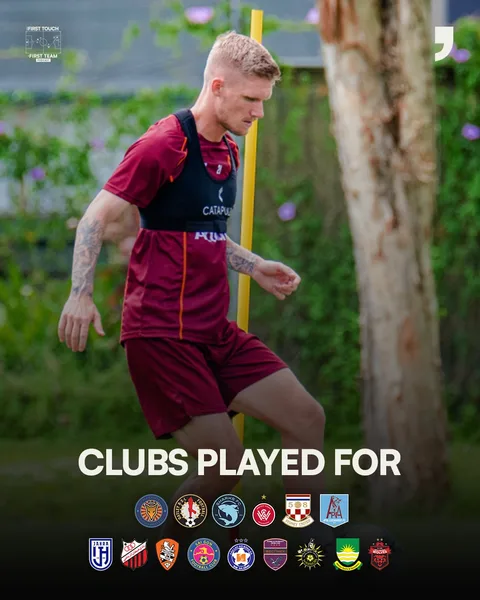
2:34 Nicholas Olsen I'm Nicholas Olsen I currently play at Sutherland Sharks in the NPL. I've played at many clubs over my career so far, overseas and also locally. I have a vast experience of the professional game and also the semi pro game in Australia.
2:48 Jan Yeah, great. that's a broad summary. When I researched you and your story, not knowing you from before, was like, okay, there's a vast list, like you said, of clubs you played for. Before we get into that, maybe take us back in time. What was your first touch? growing up in Sydney?
3:06 Nicholas Olsen Yeah, my first memory, I was born in Sydney but I grew up in Perth. So I played my early football in Perth. I played at local club there. and I got into it 'cause my my father played football. My father's background is Danish. So I started my football in Perth, all the way from under fives to under eight and then we moved back to Sydney and I grew up in the Saint George area, so I played at Oatley West, which was my first club, and then from Oatley West I went to Oatley RSL, which are all grassroots football clubs. and then from there that's when I I started my NPL career, I guess. Yeah.
3:45 Jan career, the journey. Yeah. you saying your dad brought you to football was already back then there an idol that you have did you watch games with your dad? We're like, well, I want to play like him.
3:56 Nicholas Olsen my dad played a little bit of football, he played for Aarhus in Denmark and was part of that Danish system, but then he came over for work to Australia. So it would more so be we'd just be kicking the ball at a park and as I got a little bit older, to eight and nine, I could see how my dad had a bit of quality. and then so obviously when I can see my dad could do things that I couldn't do, I was probably like asking him more questions about how do you do this, how do you do that and he got me into it more because that was his background. but yeah, I loved it since I was I'd say probably four years older, when I could understand what a f
4:29 Jan Yeah.
4:30 Nicholas Olsen was.
4:30 Jan And then would you guys back then you being very young with your dad take you to a football game? Would you guys watch football together? Would you follow the Danish league? what would you what you watch?
4:39 Nicholas Olsen Yeah, would would watch the when the SBS had the EPL on, we'd watch the the EPL on SBS and just even going down to the local grassroots fields and and watching teams play there. So yeah, watching any football we could really. And my dad would also take me down to the park, I'd it'd be a weekend, I'd finish my game and the next day I'd Hey, can be out the park and he would take me down there. So yeah, it was pretty much just all revolved around football from a young age.
5:04 Jan And you would say that you were the main driver of that. You were always the one saying like, Hey, I want to go to the park. Rather then your dad being like, okay, come outside. We're going to go train.
5:11 Nicholas Olsen Yeah. Yeah. And not just my dad, but also my mum too. If my dad couldn't I'd say, Mum, come on, I wanna get out of
5:16 Jan You
5:17 Nicholas Olsen the down to the park and kick the ball against the wall and she'd be like, No problem. So they'd always go down there, whether it was with them being involved or not, they would still be there to drop me off or just to hang around whilst I was just kicking the ball around.
5:27 Jan And you are left footed, right? So would you back then spend a lot of time with your right foot as well? Or would you say that only came
5:33 Nicholas Olsen Yeah.
5:33 Jan at a later stage?
5:35 Nicholas Olsen Probably more at a later stage or when I started to I guess get into the more serious environment. I just I never really thought about it, but I guess my left foot was probably just good enough so I didn't need to use my right foot.
5:48 Jan Is it maybe already something that you look back in now and you're like, I would have spent a little bit more time on my right foot. Okay.
5:53 Nicholas Olsen Honestly not really. Now ~
5:55 Nicholas Olsen it's probably good to have a s to be able to use both feet, but I also think at the same time you kinda look at certain players I guess a Robin or a Messi and they're heavily left foot dominated. me personally I was comfortable passing with my right foot or if I had to have a shot with my right foot, I felt like that was all I needed in my game. So yeah, when I was younger I Didn't even think about it at all really, I guess, until I got a bit older and I was like, yeah, I probably could do a bit more like work on my right foot. So I'd probably try and balance out a bit more of my own training sessions to use my right foot.
6:29 Jan Yeah, fair. I guess it's that part of understanding as well as the players what are my strengths and if you have a really, really good left foot, then of course you're going to use it more. As you already said, you then went into the NPL environment, I under 13s, how did the next year go for you? Did you find a change it get more intense, more training session? Did the love for the game stay the same? Did it become even more?
6:51 Nicholas Olsen it definitely became more I guess that's when it was probably more serious because I did play played cricket, funnily enough. and that Yeah.
6:59 Jan I can't understand that, but that's fine.
7:01 Nicholas Olsen if was I actually don't know how that came about, but when I came back to Sydney, so from Perth to Sydney, I obviously was playing football and then in the off season it's like what do you do Man, I guess my mum's Aussie, so probably you could play cricket. So I played cricket and then I got into the rep team so I was quite good. I could do a bit of everything batting and bowling and fielding. So I actually did rep cricket from elevens and twelves and then it was like, okay, now I gotta decide what I want 'cause football's in the NPL's three nights a week and it goes for majority of the year. I don't even know or remember if it was a big a hundred percent I want to do soccer or ~
7:41 Jan I guess.
7:42 Nicholas Olsen I'm I'm sad I can't do cricket. But it was like nah nah, all right, I'm gonna focus fully on on football. and then from thirteens I started training more by myself to complement my training sessions at NPL. So it was more full on, looking back, I feel like I guess after that first year in the thirteens, any go into the fourteens. I guess if I continued doing three nights a week, there wasn't that full on, and that's why I tried to complement it with doing sessions by myself. and then it wasn't until I was probably fifteen or sixteen to start to do more group sessions outside of my training. and I did that probably for about a good year, before I progressed on from the sharks to to wanderers, which happened at quite a young age.
8:23 Jan Yeah, it's interesting to say that because I always reflect on how I grew up in Germany, how I see the football environment there. doing one-on-one sessions, small group sessions, is not such a big thing over there. So people are barely doing it. what would you say is maybe one main reason that players feel like they have to do more than they get provided in the team training?
8:43 Nicholas Olsen Well, now motivation, I feel like that's a huge one. I I don't feel players have the motivation but back when I was younger, when I was fifteen, sixteen, I guess all I thought about was how I could get better and that mentality of like i if if I'm trained today and someone isn't training in the morning well I'm technically getting better than them. ~
9:02 Jan Yeah.
9:02 Nicholas Olsen I feel like these days I don't know what it is, whether it's the environment, but I feel like a lot of kids maybe struggle to get that motivation to get up at five in the morning and go do a session whereas they might feel more encouraged to be like, I've got a session with Nick today at say six in the morning and that gets the motivation higher because they're working with someone. But when I was younger whether it was a extra session with a bunch of mates or whatever, I just knew that if I could do something every single day, then that little one percent would help me going into the future or trying to trying to chase a pro contract.
9:44 Jan Yeah, 100%. obviously we both coaching, we're working in football. It's important for players to get that bit more insight and detailed coaching from coaches overall. But I think
9:54 Nicholas Olsen Yeah.
9:55 Jan so many times all you need is maybe three other mates. You set up two little goals with boots, with bottles, whatever it is, and you just play two v two.
10:04 Nicholas Olsen Yeah.
10:05 Jan And I think for so many players out there that would already make such a big impact if they were just being doing that on top of their team training once a week, then
10:11 Nicholas Olsen Yeah. Yeah.
10:12 Jan many times people probably even don't have to discuss get the extra touches in because they already got that. So.
10:18 Nicholas Olsen Yeah. No, I agree a hundred percent. I feel like we probably did that when we were younger and I think there's benefits to everything. I feel like because of my experiences, that's a huge reason why I'm getting into the coaching and trying to expand myself because I feel like a lot of people also don't know how it works and they don't know the finer details of say a one on one session, where do you position yourself? what run do you make? I feel like those things are so beneficial for a one on one. But as you said, extra touches, you just need a a ball and a wall or I don't know, I may deal with four cones or something. I just use my imagination to just create something that would replicate what would happen in a game. And then also, I remember at Sutherland when I was breaking through the first grade, I had a couple of mates that were in the 20s and would finish a a session and get the two small goals up and play two V twos and I remember that year and my mate still talks to me about it. He's like, Man, we improved so much, just literally just doing street football, two V twos.
11:13 Jan Yeah, and I would say that's probably the most enjoyable part you can get in the training,
11:17 Nicholas Olsen Well
11:17 Jan right? there's obviously so much happening in team training, but the moments where you get to play 2v2, 3v3, 4v4 is the most enjoyable part. I would say I enjoy it the most.
11:25 Nicholas Olsen Hmm. Yeah.
11:27 Jan So, we're still back in the younger ages, you said you then signed with Wanderers you went into an A-League academy. We don't have to go into too much detail what happened around that time, you played there. then you were not continuing at Wanderers and decided to go back into a non-A-League academy, just more into an NPL club again. Was that maybe the first moment where I'm wondering, where you're like, ah shit, this was my shot, now it's done?
11:52 Nicholas Olsen A hundred percent So I went there for the first season that they started. So I played in the academy there, but very, very quickly I was training with the first team full time. And then when I signed my deal there, I signed a two year deal. And then the deal came at the time where I was going into year twelve. So even at that time I I wasn't really much at school because obviously, morning sessions and then you get to school and training out of Blacktown and I was going to school around in Kogarah So you get back and you'd have an hour and a half of school. So my parents are like, well, you're gonna make a decision. do you try and balance it or do you just focus on football? And we I did try to do both at once. And it just became to the point where it's like I haven't got the time and energy to to do the schoolwork, even if I try and split it over X amount of years. So I left school. So when I eventually left Wanderers. It was like, Yeah, I guess far out. I've put everything into it, into football. And, you get that first contract and you do think in your head, Fah, I'm a professional now, this is it. I can't wait to see what's gonna happen in the future and, the heights you're gonna go to. But then obviously the other side of it is you don't make it. And then it's like, well, yeah, what's that backup plan? And I wouldn't say like that I didn't have a backup plan because I had had no probably no other choice than to leave school. But then when I finished, well, haven't played any games in the first team. Don't really know how that works. And, when you look at an agent trying to help you, what are they gonna produce to a club? They're gonna say, We got I got this player who's good, but no games in the in the A League. they're played in that national youth league that they had back in the day. But yeah. it was unfortunate. It is what it what it is. And Yeah, so then from there I was meant to go back to the Sharks, but that didn't work out. So then I went to so I I call it the NPL run, I went around to a couple of NPL clubs. So yeah, I was still so young and I was like, Well, I gotta I still gotta be in the game. and then I s
13:43 Jan How old were you at that time?
13:45 Nicholas Olsen seven eighteen maybe. Maybe
13:46 Jan Okay, yeah.
13:48 Nicholas Olsen just turn eighteen. I'm not really good with my my timeline and ages my wife for helping out with that. but I was still super young and I applied to go to uni, so I went to uni for a day and then decided, nah, this isn't for me. So it was like I'm still gonna give everything and I'm not gonna stop until I get something out of it. So I went to APIA and I played for APIA for two years, which I had a really good two years there. went to Sydney United after that before I springboarded and went overseas. but it was like yeah, I'm not stopping 'til I get something out of it. and I was I've gone too deep now, I have to see it through, So yeah, so I had the two years at RPA, one year at Sydney United. I went then back to Sutherland for for a full year. and I was still I getting trials with A League clubs, but I believe I would trial really, really well, but for one reason or another I couldn't get anything out of that. so then when I went back to Sutherland, that was when I started my overseas journey.
14:39 Jan Yeah, during that time, that's three full seasons, right? Since the first setback of being like, okay, Wanderers is not working out. I'm finding myself back in a non-professional league that's still high level. But, and you're still young, you're 18 years old, 19 years old, breaking into first team. Was there ever a point where then your parents were like, okay, Nick, what are you doing? how much longer are you going to try this? were you like, nah, mom, dad, I'm going to make it? what was that time like?
15:06 Nicholas Olsen there was never any anything from my parents saying, what are you doing? It was more just that I kinda had some plan in in place. and I was working at a cafe, I was getting okay money at NPL, so the whole balance money wise was was good. I was still young. they were just they were always very supportive. When they were younger, they were always said to me, obviously parents put a lot of time and energy into a kid's footballing career too. They always said there's no pressure from us. If you ever want to stop playing, you can stop. so there was never any sort of pressure from my my parents at all. I guess that pressure pot came from myself. But I just yeah, I'll just tell them all the time, I'm I'm not giving up. from when I finished Wanderers, when I left eighteen to probably twenty six, equivalent of probably honestly, four weeks off is what I had. Even when when I would f have holidays, I would train every single day. I would give myself no chance to leave anything unturned and that's I guess the reason why I I I after I finished at at Sutherland and then I went overseas, I I believe that's the reason why I got a chance again in the in the professional environment.
16:17 Jan And one, you got a chance, but two, you were also ready for that, right? Because if you
16:20 Nicholas Olsen Yeah, yeah.
16:21 Jan maybe would have received that call, but you would have already just training two and a half days a week, three times team training, playing one game, you're like, ah, this is enough. You probably wouldn't have been fit enough. You probably would have been not sharp enough. So that's a good one. I think another
16:30 Nicholas Olsen Mm. Yeah. Yeah.
16:36 Jan important point that's for me is such a, I don't know, not many people talk about this here in Australia, but as you said, you... You were working in a cafe to have a bit of work like balance of football, have a different job, get some experience, whatever it is. But I said it to a lot of parents and players here. One part is obviously you want to give everything to go to the professional level, to call yourself a full-time professional and just earn money from playing football. But at the same time, there's so many young players that stop where I'm saying you're 18, 19, 20. If you're playing NPL, you're playing semi-professional football. Yeah, you can earn some money on the side that all your mates that are finished school that are studying, they're going to have to do that in a job that they probably don't enjoy as much. You're
17:22 Nicholas Olsen And yeah.
17:24 Jan getting the same amount of money from playing football.
17:28 Nicholas Olsen Yeah.
17:28 Jan So that should still be a goal, right? To make it to these levels where you can say, I can subsidize my everyday life, my uni, whatever it is from just playing football.
17:37 Nicholas Olsen Yeah. Yeah, a hundred percent. obviously you ca have a good conversation and good relationship with all your players and the kids that I coach, even the ones that's teenagers, it's like you have to ask that question is what one, why am I doing it? And two, what do actually want out of football? from a young age, I was like, I just want to be a pro. As you get a little bit older, then you get a bit more of an understanding of how it works and you get a bit more realistic as to where you are level wise. I used to always tell myself why I did those extra training sessions is like I'm gonna play for Manchester United one day. I'm gonna play for Manchester United one day. And then when I hit like that nineteen, twenty, you know what, no disrespect to myself, but I probably am not gonna play for Manchester United, but I know I can still play pro somewhere.
18:16 Jan So then take us to the time where you then, made the decision to go overseas. How did that come about? How did that happen? And was there then a moment like, should I do it? Should I not? Or were you just like, okay, this is my chance. I'm going to take it.
18:28 Nicholas Olsen Yeah, so my opportunity that came overseas, it wasn't I guess how everyone probably thinks, yeah, so I went from Sutherland and then signed over in Kuwait. wasn't that easy. I went over there on a trial. and a mate of mine he had planted the seed six months prior. He was a really good mate of mine. he had done some agent work and I just I bumped into him at a at a training session once and just asked him what he was doing, if he had any contacts, all that sort of stuff. Said I'm still chasing it. Said that he would be willing to help out. So he just reached out to obviously his contacts and then told me that six months' time potentially there could be something for you to go overseas. didn't hear from him for for about six months and then it was December time. He he called me and said, Look, I think you you have have an opportunity to go to Kuwait. You'll have to fly in a week. And I was like, okay. it was around Christmas time, I was with my my partner and and her family, and I was like This is the only opportunity I'm gonna get. I've got nothing else here. And I wouldn't say it was like that light bulb moment where it's like this is it, this is a last chance sort of thing. But I was like, I've got nothing to lose here. obviously it was going to the preseason of NPL, so I was like, I'm not gonna miss anything here. so I was like, just go over, give it a crack. Got two weeks over there and whatever happens, happens. and then I'll make my decision after that. So I went over there, did a two week trial. had a couple of issues with getting the paperwork done because they were trying to get rid of some foreigners which obviously cost them money so they were trying to organise that. and yeah, I I spent all my last dollars going over there. and I after the two weeks came up and I didn't have the contract in front of me, I kinda said to the coach, What's what's happening? Are you interested? And he said, We wanna sign you but we have to wait to get rid of these. foreigners, it was two of them, and I said, Look, I have no money, so I'm gonna go back home because I need to start working again to make some money. If you do want me one once you finish their paperwork and finalise those two players, then please contact me and my agent honestly said to me, I don't think he if you go back home you're probably not gonna get anything sent through and it was just lucky enough that They were true to their word because in Asian countries and the Middle East it's doesn't work like that. They're not as, I guess, honest as they should be. so I came back home and contract was sent through a day later and then another day later I flew back and started my pro career there. Yeah,
20:51 Jan Hahaha
20:53 Nicholas Olsen it was a good little tip to come home, say hi to everyone and then say see ya later. So that's how that came about. and then
20:59 Jan And you know what, it's one of these stories where everyone thinks like, I'm signing a professional contract. It's going to be magical and ~
21:06 Nicholas Olsen This is
21:07 Jan I'm going to, get picked up at the airport, red carpet, everyone's there. But for you it was very different. But again,
21:11 Nicholas Olsen Yeah. Yeah.
21:13 Jan you reach that one, that level of being a full-time professional and then playing in a first division in another country, but being
21:21 Nicholas Olsen Yeah.
21:21 Jan a pro footballer.
21:23 Nicholas Olsen Yeah. I don't know, I think I might be different to some other players, but I'm very open minded. I wasn't going there expecting I'm gonna be living in an amazing apartment, I'm gonna get given this amazing car and all this stuff. it's an opportunity for me to start my career. I have no idea what it it entails,
21:40 Jan Thanks.
21:40 Nicholas Olsen but at the end of the day it's it's a pro contract. And if I can get that then why not give it a crack?
21:46 Jan So then maybe give us one or two insights what is it like to play pro football, everyday life training in Kuwait.
21:54 Nicholas Olsen So this is now another side of the story is all the players in Kuwait, the local players, they all have another job. So this is something I found out whilst I was there. really, really interesting 'cause obviously they have five foreigners, I think they maybe have seven now in each team. So you're a professional player, you have professional contract. The local players get paid, but they also have a job too, but In Kuwait it's very different to any other country. All the local people it's either a government job, so teacher, police, or they have their own business. No local Kuwaiti works in a cafe or a restaurant or something. They only either manage it or
22:33 Jan Okay.
22:34 Nicholas Olsen it's yeah, it's it that's how it works over in Kuwait. So I when I found that out, I was really taken back, I like, Wow, what's like it's a professional league, I'm on a professional contract, but the other players have another job too. The players are serious, but at the same time they've also got day to day jobs too. So
22:51 Jan Yes.
22:51 Nicholas Olsen there's no Kuwaitis that leave they never leave their country. So their ambitions for the local players is like if they can play in the Kuwait Premier League, then they've made it, right? Which is like our NPL. Yeah. So then
23:02 Jan That's a goal achieved, okay, yes, well.
23:04 Nicholas Olsen it's like on the other hand, when you come to Australia and the foreigners that come over, a lot of them are trying to chase to get into the A League or to bounce off to somewhere else and they come and th they do NPL full time. So I was experiencing that over Kuwait, yet I was on a professional contract and I was getting much more money than I would have got in the NPL. So it's like really interesting, bizarre situation. But I enjoyed the living standards. I enjoyed the culture. the football was of a decent level. And I was a professional footballer, so
23:35 Jan Was there some football culture in the country? were the people crazy about football? is the
23:39 Nicholas Olsen Yeah, they love football.
23:40 Jan stadium packed?
23:42 Nicholas Olsen So when I first got there, the the club I played for, they normally have a lot of fans, but they were dead last, so there was not many. There was a maybe a couple of hundred. but I would say during that time when I was there, the football wasn't as I don't know, as followed, the Kuwait Premier League. La Liga, English Premier League, they'll talk that that's all they talk about. Pretty much everyone
24:00 Jan That's
24:00 Nicholas Olsen in the country will talk to you about football, not a problem. But they didn't really go out and watch the local league. I was there during Covid time. After COVID happened, and I guess a lot of people were stuck indoors, I think it's since I've left it's flipped in its head, there's they're getting eight thousand plus to their games now with heaps and heaps
24:17 Jan Allah
24:18 Nicholas Olsen of fans. And don't get me wrong, there was definitely clubs like Kuwait Club, Al Arabi, that had lots of fans. a huge fan base, but whilst I was there there wasn't any games where I was like, wow, there's heaps and heaps of of people here unless it was a final Which unfortunately my team was never part of, but if it was a final that I went to watch to I'd like, this is where all the fans are.
24:37 Jan Okay, yeah. So you did that part Kuwait, then after that the next step is back to Australia, right?
24:46 Nicholas Olsen Yeah.
24:47 Jan Was that then the moment where you're like, okay, now I've signed my first proper pro deal, I've played pro football, now I'm coming back to the A-League. Was that more exciting to you coming back to Australia or was it before
25:00 Nicholas Olsen It was
25:00 Jan more exciting going overseas?
25:03 Nicholas Olsen I think yeah, it will was definitely excit 'cause I always had a football bucket list. I always wanted to play in the A League. I wanted to make sure that I could finish my career and say, Hey, I played at the highest league in my country and that's something I can be proud of. So it came about because I knew the fitness coach there. and being honest, the level in Kuwait is probably in between NPL, A League. Some teams could compete in A League, but some teams could maybe just compete in the NPL. It's not really a known league, so I was like Whatever, I'll I'll give it a crack and see if anyone would take of any interest. And I think you'd probably speak to a lot of players that I think you can go overseas and play in a a pro environment, an unknown environment. But if you have a professional contract, they see it differently in Australia. And I guess me playing in Kuwait full time professional.
25:54 Jan They were like, player must be of a decent level.
25:56 Nicholas Olsen yeah, because he must be train he's training every day and yeah, in a pro environment and etcetera, et cetera. So when I reached out to to Brisbane and the friend I knew, he spoke to the club and look, the the the club was interested. the phone call that I got was pretty much like we're looking for for a a left wing back. Corey Brown at the time was playing left wing back and we need a replacement. Can only offer you minimum wage, and I said Don't care about the money. I just want to be able to make sure that I can say that I've played in the A League. So that's how that came about. And it was exciting because I'd been playing a lot of first team football for a long time. So I felt like my mentality had shifted a bit from being like that younger boy to being that player that had a bit more experience.
26:34 Jan concepts.
26:36 Nicholas Olsen So I thought getting back into the A League, I thought I had a better chance than I guess last time.
26:40 Jan you made a very interesting point the topic of how players are seen that are playing overseas and coming back to the A-League. Because I feel like that's an ongoing topic with youth players as well that for some reason, A-League clubs, A-League teams, sometimes they have the players in their own environment. They maybe have them at other NPL teams. No one looks at them. Then this
27:03 Nicholas Olsen Yeah.
27:04 Jan player goes overseas somewhere in Europe. They're trialing like... I think Adrian Segecic is a perfect example of that. was like, I think a few years ago, was at Sydney FC obviously, didn't really have anything to do with a contract, then went overseas, trialled at a few different clubs, out of nowhere and everyone's like, oh, someone might be interested in him, do not miss out on him, he's trialling there. And out of nowhere, the elite teams are like, oh, we have to give him a contract. And
27:28 Nicholas Olsen Yeah.
27:29 Jan I'm like, guys, all of these players are in front of you.
27:31 Nicholas Olsen There we go. Yeah.
27:33 Jan Why do you have to get them, why do they have to go somewhere else to show that they can do it over there? For them, you saying, they must be good enough. Because you were in the environment here the whole time,
27:41 Nicholas Olsen Yeah. I feel like that's not yeah.
27:45 Jan someone could have looked at the games and be like, this kid got something.
27:48 Nicholas Olsen Mm.
27:49 Jan He obviously made it overseas. And now only after that, we're looking at him.
27:53 Nicholas Olsen Yeah. I don't know, 'cause I was in and around it. I feel like I almost trialled with almost every single A League club and everyone kinda knew who I was because I'd obviously been around and they knew I was a decent footballer, but it wasn't till I went overseas and maybe a connection at the time because obviously I knew the guy at Brisbane, like that probably helps too, but I guess the reason why it's probably good that players go overseas and then they get noticed is one, I think football's about opinions. Football's huge on timing. and if you go overseas, you're not a rarity, if you say you come from an NPL team, it's like there's so many NPL teams, everyone knows all these NPL teams. At that time the coach might be like I don't know, they had a say it's against a Marconi or something, and they're like, I remember when I played there or played against them and the environment, whatever it could be, it could be some silly excuse for for them to not have a look
28:41 Jan Yeah.
28:41 Nicholas Olsen at a certain player or whatever or even take interest. But when you overseas and there's this player Nick Olsen he plays in the fourth division in Slovenia and they'd straight away be like he's playing in Slovenia. Who is this kid? You know what I mean? And it's a little bit more exotic,
28:53 Jan Yeah.
28:55 Nicholas Olsen right? It's like, well let's have a look at him. And there could
28:58 Jan Yeah.
28:58 Nicholas Olsen be better players in the NPL Or wherever it is in Australia, in an academy or something. But it's I guess also unknown identity. And I think that that's the reason why you be then become a bit more of a standout in comparison to a player that maybe play has played say a hundred NPL games at the age of eighteen
29:16 Jan Thanks.
29:17 Nicholas Olsen and they're like he can obviously hold himself as a butt nah. it's only NPL or whatever their excuse is, right? I feel like that's the reason
29:22 Jan Yeah, yeah. mean, as we're discussing that, feel like maybe over the last years, you can tell it's changing a bit. especially this year going into the A-League season, there's been a few more players that have been picked up by A-League clubs that were playing NPL.
29:37 Nicholas Olsen Yeah. now it's eight different.
29:39 Jan So it's happening more now. I feel like it's happening way more. I don't know if I'm just more aware of it's actually more players getting these chances. But over the last weeks, have been a few signings. So guess that's a positive that the A-League are recognizing, hey, there's talent in the NPL in the younger age groups that we have to have a look at as well. Maybe give us a comparison in terms of level, what was the differences between Kuwait and then the A-League was there a big difference of the way the game is played, the way training was organized, the way the standard was?
30:12 Nicholas Olsen Yeah, the a few differences. I think the reason why Kuwait is different in terms of their footballing way is because it's super hot there. So the games are slower. but most of the coaches there, eighty to ninety percent are foreign coaches, so you get really good coaches with good pedigree. I would just say that probably the level of the local players, depending on which team you are at.
30:33 Jan and what job they have on the side.
30:35 Nicholas Olsen Ex yeah. And how tired they are from a day's work. is is like will determine the quality of football, say that your team will play. Kuwait have very, very good individual players 'cause a lot of them just play street football. so individually they're very good, but I feel like a lot of them maybe lack the tactical side of the game keeping you shape and and that. So a lot of games in Kuwait are so open. And me that was more open than the A- League. Yeah.
30:56 Jan Even more open than the A-league, wow, okay.
31:01 Nicholas Olsen But 'cause I was a winger, pretty much as soon as you get the the you win the ball back in a transition, it's almost like just a direct ball to the wingers in a one on one, always in one on one situations. and then obviously the standards aren't as high, in comparison to an A League. and that's I guess also because players, right, had other jobs, so they had other interests and stuff like that. and then I think The A League the the intensity is just so high. I haven't had heaps of experiences in a lot of European countries and stuff, but I feel like the intensity of of the A League is so so high. it's become as the years have gone on, because of I think the younger players being involved and getting more chances, it's become a bit more open and transitional. But I feel like in the A League it's less of the sometimes tactical side and it's always like I think memory every team presses no matter what. High, high press,
31:47 Jan Yes.
31:48 Nicholas Olsen high intensity, and it's like non stop. And I feel in comparison from Kuwait to Australia, the intensity of training was s way high. You can't really compare. the intensity of games was super high. And I would say the quality is not unbelievable. But it's just those little details of a good pass. you're not missing a pass or understanding where to position yourself in the game. though those are the huge differences.
32:08 Jan So while we're already on that topic of discussing differences, then maybe we go on to the competitor to your next stations that you had after Brisbane, I believe you went to Vietnam.
32:18 Nicholas Olsen Yeah. And that was a real, real weird one.
32:21 Jan Okay, take us into the journey.
32:24 Nicholas Olsen Yeah. I'd started sixteen games, I played nineteen at at Brisbane in the A League. And then that was another one where it was like Okay, my mentality changed. I thought, okay, I've played a fair few games in the A League. Not like surely I'm gonna get another contract, but I'm like I've performed quite well. what happens next is really gonna really I guess change my mentality and how I'm gonna perceive my future in the game. So when I finished there, most of the games I was left back, left wing back and compared to everywhere else I've been, I would not have been happy playing left back or left wing back. But I don't know, the mentality of being home and I guess being comfortable in my environment and and that sort of thing and just being home I was like if I can get another contract at either at Brisbane or at another club And they want me as a left wing back, my mentality was I'm gonna try and push to become a Socceroo. Cause I was like, I'm technically better than all the left backs out there. I'm fast, I can read the game really well. if I can get something out of that, I'm gonna do everything I can in my power to be out there and people be This this guy could potentially, be a Socceroo candidate, right? Didn't happen. So I was like, that's out of question. Then when I left Brisbane, it was for one it was more money and they obviously knew I went there on minimum wage, so I was at an age where I had a partner, we're getting married, you do need a bit more more money. and that didn't really work out. There was no real conversation about we're gonna keep you or not. It was all positive, we love ya. You've been so professional, been a great addition to the club. If you need any help, going somewhere else, we're willing to help you out. And I was like, what am I supposed to do with that? But whatever that door that door's closed. So then reached around to a couple of A League clubs hoping that I could get something out of it. Couldn't get anything out of it. And then I was in that no man's land. So I was training again every single day, preparing myself, making sure that I was ready for something to come up. And when you go in the A League and you start to play like I played in Kuwait, you start to be in that transfer market. You'll always have people messaging you. Instagram, Instagram agents, whatever. WhatsApp agents, all these ones that they get your number somehow and then they start messaging you. So obviously I had a couple agents that I'll I would always be in contact with that I had a good relationship with. And yeah, I think it was a month after I'd finished the A League season, it might have even been longer, and I was getting to that point where I was like, Everyone knows me in the NPL. I think it's time to wrap it up and be like, It's NPL now, right? And then I just got a random message from a friend of mine saying, we need a player in Vietnam. Are you interested in going? And I was like, I'm going, man. when do you need me? when do I need to go? And he's like, Well, if you can agree to the terms, then you gotta go tomorrow. So and this and this again was a trial, right?
34:54 Jan Wow. Good that you already back then were open-minded,
34:58 Nicholas Olsen Yeah, I know, right? And and this was also this was a trial, right? So I guess when when I was a little bit younger and y you don't want people to it's weird, you don't want people to think, I went on a trial because then they think I guess or you weren't good enough to sign straight away. But in these certain countries, when you get there, you gotta under like a lot of people then understand is that there's a lot of players that come from other countries that, ~
35:22 Jan Peace.
35:22 Nicholas Olsen you see their highlights they're unbelievable. But
35:24 Jan I will.
35:25 Nicholas Olsen then they get there and you're like what what is this? this isn't the player that I saw in a video, right? And it happens everywhere. Even in the
35:30 Jan Yeah. Yeah.
35:32 Nicholas Olsen the top top leagues where you sign these players and then after a year you think, what happened to this player? He wasn't the same as he was before, right? but these these guys take it literally. They're like, no, we're gonna we're gonna see you train first before we we sign you. and I didn't know that before I got there. It wasn't perceived to me as that that that's what was gonna happen. But a couple of days after being there that's I kinda got the idea that they wanted to see me first. and that was strange because players had when I found out after their trial for six weeks, two months, right? before getting something or or nothing at all. and totally forgot the window was closing in two days. So I trained for one day there. It was torrential rain, puddles everywhere on the field, so I literally having a laugh on the field thinking What is this? Flicking the ball up and hitting volleys across field and stuff like that. And then after that session, the agent came upstairs, into the room and goes, Look, the the coach wants to see you for another day. And I was like, really? He wants to see me for another day? And he's Yeah, he wants to see you for another day. I like, whatever, man, it what it I'm here now. Let's do it. Goes out of the room five minutes later, comes back in the room and goes, we actually haven't got time. The window's closing soon, so we gotta go and sign you. So So I went from from being like, What am I doing here? This is the funniest introduction into Asian football. and then it's like, yeah, we're gonna get
36:47 Jan Man, your long balls must have been on point, huh? For them to be like, you got a good touch.
36:51 Nicholas Olsen my flick ups were good. My flick ups were really good. So yeah, so that was super, super strange and I didn't understand that whole process of trialling and stuff and it wasn't until after I signed that I had all these agents messaging me and saying, Congratulations, how long did you trial for? And I like, Why is all these people messaging me about a trial? and they do in a lot of Asian countries and I get it. Their their mentality is a trial before you buy thing. They want to make sure that they see these players in person first, because unless they're a a well known player who's played at say say play I don't know a hundred games in the A League and are consistent they're kinda like, Well, we don't know what we're gonna get. so yes, that's that's
37:25 Jan Especially if they're coming from leagues where you can look really, really good on a highlight reel but no one actually has an idea what the standard is like. So I would protect myself as well.
37:34 Nicholas Olsen exactly. Yeah. Yeah. And I get it, but then also at the same time it's like as a player's point of view, say you get a top player from the A League that's I don't know, their transfer market's half a million, they've paid a hundred and fifty games. How as an agent over there, how do you explain it to the player saying that the salary is very, very high if you sign but you get a trial for two weeks? then you're gonna get you're not gonna get the best players sometimes, right?
37:57 Jan Yeah, because players don't want to take the gamble. What if you injure yourself doing that trial? But I guess
38:02 Nicholas Olsen one hundred percent.
38:03 Jan for you, it's good that Your mindset was maybe okay, if I don't go there, take another risk, I might have to just go back to NPL So good on you to take that gamble, to take that risk. Pick a few good balls with your left foot and then sign another professional contract.
38:16 Nicholas Olsen That's all you need to do. Ping a couple of Zinger burgers and that's it.
38:23 Jan All these touches that you did when you were a young kid and hitting against the wall probably helped with that.
38:28 Nicholas Olsen Yeah, yeah.
38:29 Jan You've set yourself up for that. So then you play Vietnam. also, because I'm just checking my list, you also went to the Maldives. So you've been around what would you say, what were the main parts that you took away from all of these different places that you played and the different teams that you played in, that you were like, this is what football is about and this is what maybe you learned the most from it.
38:52 Nicholas Olsen I huge shift in mentality. not the mentality side of things of train every day. I think that was a non negotiable I had to do that. But more the mentality side especially in these Asian countries and I don't know too much about your EPLs and and League Ones and stuff like that, but in the Asia and Middle East it's just it's so selfish. you have to just worry about yourself and be expected to be put in these unknown environments with maybe not good living conditions and and things like that. So the biggest thing I took away from it was you just have to be like willing to sacrifice so much, to get that end goal. And a lot of people I know that would have been in my situation, wouldn't have gone through with maybe a Kuwait or Vietnam for X reason but I think that's that's the biggest thing I took away from it. Is like if you really want something you have to give up everything and you sacrifice so much going to these places,
39:41 Jan What would you say were the main positives or highlights from these times that you you experienced?
39:49 Nicholas Olsen The biggest highlights was probably my first five weeks that I was in Vietnam where I just absolutely went in a maze because I'd gone from playing left wing back in the A League to then playing a number ten role in Vietnam. And in eleven games I got five goals and three assists. And that was like a springboard into I guess my next contract, which was helping me get a lot more money than I could ever have imagined. so that was one of the biggest highlights. And then I had one of probably the lowest highlights which came po probably six months after when I had signed with that next club and had a lot of money and I guess a lot of expectations. But then it was like that's when I really realised it's like especially in these countries, it's a team game, but it's not really because you're you're expected to do everything and you're expected to get these goals and get these assists and that year I had after I got I went to another club after halfway through the year and I I I wouldn't say I didn't do anything because I watched my highlights back then and I was super effective in helping the ball get forward and get entries into the box and stuff. But statistically I did nothing. I got no goals and and no assists. And that's when it hit me real hard realizing that man, even if you have one good year it doesn't it doesn't mean nothing, it's that consistency. And it was like I did so well in that first club that I went to in in Vietnam, then then after it was question marks whether it was a lucky year from people, whether he really was that good. and then that that was a low point where I realised if you really want to be a pro in these environments, 'cause in the A League some players can be an attacking player and go three years without scoring a goal and they still sign an extension, right? ev everyone sees it and everyone talks about it. But I guess it's also more of the faith and you they can see that there's potential there for the the player to get better. Whereas in Asia and and Middle East there's no they don't care about potential really. They just care about results and and instant success.
41:44 Jan So I'm wondering then if you could go back in time, would you say in that club that you were in where you had an amazing season, would you, stay another year there rather than signing with a new club?
41:54 Nicholas Olsen The club went bankrupt, so I couldn't.
41:56 Jan okay, so not true.
41:58 Nicholas Olsen I wanna I was gonna stay there.
42:00 Jan You
42:01 Nicholas Olsen but there's actually a huge article out, the Daily News or whatever did one, but the owner, the one that was funding all the money, actually tried to to flee in a private jet with five billion US dollars. So yeah. So they shut down all the accounts, stopped paying players, and yep, club is no more. So I had no choice.
42:21 Jan Okay.
42:22 Nicholas Olsen I would have loved to 'cause it was an amazing club. It was right in Ho Chi Minh City. and yeah, a great team environment, great players, great coaches. But it just unfortunately didn't work out that way.
42:32 Jan What made you come to the point where you then were like, okay, I'm done with this. I want to go back home. I've achieved what I wanted to achieve. I've made a professional career, but now it's like time to come back to Australia.
42:46 Nicholas Olsen I was never done with it. I still kept chasing it. I still kept messaging agents trying to find other options to go to different countries. I just never had an offer that I felt was I I don't know, I was maybe a little bit naive in that sense that I thought because I'd gone from X amount and getting such a high salary that I felt like I deserved that. when I didn't I guess come to the realisation that it's like well I personally didn't do much at all and I probably didn't deserve that and I but maybe need to take, a couple of steps backwards to start again. So I came back to Australia and I was training nonstop, waiting, waiting, waiting, waiting. and I probably could have signed and finished a half season with NPL. but I still felt like, nah, I'm not ready for that. I wanna keep going and I know that if I sign in the NPL it's like that's it. Only because I think a lot of people a lot of people don't know how it works but When you get a figure on your transfer market, people look at it and they say, he's worth 150, 200. People take notice of you in the pro environment. when you go to the NPL, it goes to nothing and your market value says that you're not worth anything. So I was like, I'm gonna keep going and waiting to get something. And
43:56 Jan Yep.
43:57 Nicholas Olsen unfortunately, I think it was maybe six months, I had nothing, and I was like, Look, I'm spending money here. on a limp that I'm gonna get something and I haven't got anything, I said I kinda think I gotta bite the bullet now and find something in the NPL. and I knew everyone in the Sydney NPL and I know that I'd be comfortable with know everyone, but I still wanted a challenge. So I was like if I'm gonna do NPL, I'll go to Melbourne and my parents are there, so I was like, I can stay with my parents for a bit. Hadn't seen them in a while, obviously from being overseas so I decided I'll come back to the NPL. But I'll give it a crack in in Victoria first.
44:28 Jan Before we maybe go into that chapter
44:30 Nicholas Olsen No.
44:30 Jan of NPL, you've obviously made a lot of learnings, experiences in Asian countries. You ended up being a professional footballer. What advice would you give to players that are looking at these kind of environments, these kind of countries, Asian leagues, what to be aware of, and also maybe what mindset and mentality shift to have before you go to be able to succeed.
44:54 Nicholas Olsen I think as a player you have to be open to everything. So that's first of all, if you're not open to everything to try and be a professional, then it's probably not for you. everywhere you go, if it's not Asia and it's in England or or or Europe, you have to be careful of the agent and you gotta probably ask more questions to an agent. But I think the biggest thing for me is if you hear something from an agent that a team's interested, think you need to reach out to players that have played there and if they know that agent and I guess find out a little bit more about them to make it more safe. ~
45:26 Jan Yeah.
45:26 Nicholas Olsen and then also I feel you have to expect the worst as a player to go over in terms of whatever it is, living standards or 'cause I think also a lot of people don't realises when I went to Vietnam, I was so blessed that the club was in Ho Chi Minh. There's a lot of places that don't have anything and you've also got to find out I guess where you're gonna stay and where you where the club is situated at because if I say I went to Vietnam and I was at a a club that was isolated and had maybe one coffee shop then that would also make, decisions different too. So I think as a player that's going overseas, you have to be open minded and you have to be ready for anything that's going to be thrown at you. but at the end of the day, your mentality needs to like what are you chasing? And it's a p professional contract. And there's gonna be there's gonna be bad times, there's gonna be good times. Majority I think if you're playing in Asia and just football in general, I think, there's a lot of struggle. but I guess getting that pro contract and being able to live the dream about being a pro is probably the biggest success, right? 'Cause that's that's what you've you train your whole life for, just to be a pro and to be a full time footballer, not to be worrying about do I have to study, do I have to get another job? that's obviously the dream. but you have to sacrifice and be willing to sacrifice a lot to get there.
46:40 Jan And like we said at the beginning, it's also during that time, three, four, five, six years, probably a lot of mates that you started to play with, that you maybe played under 16s, 18s, 20s with, they already had to grind through every day life. They had to take a normal job. They maybe had to do jobs that they didn't enjoy. In that meantime, even though you had your challenges, even though you had your struggles, you were just focusing on football the whole time. Yeah.
47:06 Nicholas Olsen Yeah. And I think a lot of people forget that too, 'cause when I was a little bit younger, when I started to train with the first team at Sharks. I remember I heard from someone, this player said the only reason why you're at first grade is because all you have to worry about is football. And it's like I remember hearing that and thinking, But that's the re like I'm looking down in the track why I became a Pro but that's the reason why. you do have to have a backup plan, I do feel like, especially nowadays. Which is like you could argue whether that was a the right thing to do or wrong thing to do for my part. But I got what I wanted in the end. I wanted a pro contract. So I gave up everything and just focused on football. And I feel like in certain things that that's what you have to do. And if you don't, if I hadn't have made it, I still would have said, you know what, I trained every single day, trying to get there. I did everything I could, yeah, maybe I just wasn't good enough, But because I just never gave up and was just relentless, putting in that effort, just messaging people and trying to open up avenues, I eventually got what I what I deserved in the end because I put in so much effort. And I see kids these days that they want all these things given to them but they just don't I feel like the mentality is so so different to I guess when we were younger, whereas there's so many avenues now for players to get better that
48:16 Jan Yes.
48:17 Nicholas Olsen I don't actually think that they really utilize it to the to the maximum because it's easier to get that extra training but it's not easy to get up early by yourself and do a session by yourself, ~
48:28 Jan it even starts with the topic of you're now everywhere, even some grassroots level, can you have game footage of yourself.
48:36 Nicholas Olsen Yeah.
48:36 Jan I don't know about you, but for me, it only started until when I was under 15, that we would sometimes have games recorded that you could actually review yourself. And that was on the second highest level in Germany, because back then there was cameras were too expensive. That wasn't the thing. So now players have all of that, but they're not using it. So I would say for anyone that's playing NPL. Man, as soon as the video comes out, re-watch it and be harsh on yourself and be your biggest critic and you're gonna learn from that as well.
49:05 Nicholas Olsen Yeah. Yeah, it's insane 'cause my first ever video on YouTube was from my dad recording me.
49:10 Jan Yeah.
49:11 Nicholas Olsen And I didn't get footage until I started playing first grade at Sutherland, when they had the the YouTube's out. and I'm thinking back now I can't even remember whether it was live or whether it was just recorded
49:23 Jan Probably not.
49:24 Nicholas Olsen and had highlights, I can't really remember, but now it's like like I coach at grassroots, and they get Veo there's always excuses, right? But there really is no in my eyes, there's no excuse for you to be able to get better than what you are with all these
49:38 Jan Yeah.
49:39 Nicholas Olsen tools that are available, And then sometimes that's like the devil's ad advocate, maybe there's too much
49:44 Jan much.
49:44 Nicholas Olsen and then people are like doing a bit of everything where they should just be focusing on one thing.
49:49 Jan Yeah, 100%. So while you're now on the topic of you obviously then came back to the NPL here in New South Wales, you find yourself playing NPL1 you were at Wolves you're now at Sharks. When you look at the level, how does it compare? obviously everyone has to consider that a majority of players in the NPL are having a second job, they're having to work hard. They're maybe not like the guys in Kuwait where they have jobs where they're the manager.
50:14 Nicholas Olsen Yeah. Yeah.
50:16 Jan They maybe actually have to work in construction, they're on their feet the whole day, they have stressful jobs, physically demanding jobs, and then still are delivering the quality there is each weekend. How does the level compare and what would you say, how big is maybe the gap to the A-League?
50:32 Nicholas Olsen I think the gap to the A League, it's still huge. But the only reason why it's huge is because of that intensity. I think the quality of players is there. One hundred percent in the NPL.
50:42 Jan Yeah.
50:43 Nicholas Olsen There's no doubt about it. It's it's for me it l it it really is just as simple as the intensity. players can run more because they're fitter. They can do a high press for ninety minutes, whereas in the NPL The players just can't do that because they're a lot of people are doing physical jobs, right? but in terms of the quality of players there's not there's not that big that big a difference.
51:05 Jan So you would say technically similar level, not that big of a gap, maybe Tactical understanding not that big of a gap as well, but that physical part from the difference of training maybe three, three and half times a week to training six, seven times a week is the big difference.
51:20 Nicholas Olsen It that's the biggest the biggest factor, yeah, because it doesn't matter whether you're doing the right or wrong training, if you're training seven seven days a week, you're gonna improve no matter what. Your touch is gonna get better, you're technically gonna get better, you're gonna get fitter, right? obviously the A League is the best of the best and you do have some NPL teams that they have four or five really top players and the rest are, good for NPL that probably might not be able to be at that A League level. I would say that there are so many quality players that could play in the A League. there's but there are also some players that are probably, just top for the the NPL level. So that's the the biggest thing is when you have these Australia Cup games, right? you've got say a full squad of, Perth Glory, that they're they're full time, they're training every single day. And then you've got Queensland Lions, beat on penalties. They're like you might have half the team that are like They're they're working part time, but they're also doing extra training too, because they want to get better. So it's like you've got those four or five that it's like they could really be in an A League environment, but they're not, and then the rest are like they're balancing just that football and and work life. So that's another factor that you have to to take into consideration. But I feel like if you put an NPL squad training full time, just like the A-League team, I would say even now that they could compete, but I feel like if you gave six months a lot of these NPL clubs could even run over A-League teams.
52:37 Jan How about football overall in Australia from maybe the time that you left to go to Kuwait to then now since you're back for the last years?
52:46 Nicholas Olsen That's a great question. I feel like from an NPL space, from a from a first grader space, I feel like it's growing very, very well. the the football is run really well from a first grade point of view. I feel like in the youth space I feel like there's a lot of confusion. we didn't have all these JDLs and academies and I know there's so many other things that are going on with clubs and people have no idea what's going on. And I know that people are drawn more to academies because the people that run academies have more pedigree and probably have more of a background in the football space. But then there's that transition from a academy into a NPL team which is like real fuzzy, I think, currently at the moment. obviously I'm being quite new into the space and I don't have teams as such yet. but I feel like we've maybe gone backwards in terms of having a system. I feel like in Australia we don't have the greatest system set up and and people don't really know what's right or they don't really know what to believe is the best process for their kids whereas I feel like probably when when you're in Europe, if you go from a Bundesliga's team's academy, you wanna get played for Bayern Munich, you all you gotta be in their youth system and work work your way through there 'cause they're gonna have great coaches and they're gonna have a great system and environment and et cetera, et cetera. Whereas here it's like you don't know.
54:13 Jan You don't know. Yeah, I think the biggest part is that there's no clear pyramid that leads towards the top. And no one really knows what, everyone knows like, okay, the A-League is here and A-League Academy is here, but no one really knows like what are the steps below that? How do I actually get there? What do I have to do? How do I get selected in a state team? What training should I do? Yeah, I think you're spot on with the observation that it's very blurry and no one really knows what to do. It seems like no one is really happy
54:46 Nicholas Olsen Yeah, yeah. Yeah. A hundred percent. No one no one's no one is happy. I think everyone's always trying to point the finger at someone else and it's their fault or should I go there, should I go there? if you have a coach or you have an academy that you've been there and you can see the environment and that they're there to help the players. and your your kid, for example, enjoys it, well then that's probably the best environment for them, right? Because they're improving and they're learning a lot. on the other hand it's like, well, okay, they're gonna get that learning from them. So then do you go and do extra training with them and then play at an NPL team because that's where you wanna be? Or do you just stay with the academy, play games with them and then the NPL team doesn't know about and then it's like Yeah, it's at that you need to go away
55:26 Jan And that's the kind of part again where there's maybe
55:30 Nicholas Olsen Yeah.
55:31 Jan a great player somewhere but no one knows him because he's still in that grassroots space, right? That's the biggest
55:33 Nicholas Olsen Yeah. Yeah, exactly.
55:36 Jan part where I'm like, there's probably so many talented players out there that are not seen because they actively decide, all the politics and all the drama is too much for the parents and the person's like, I just want the kid to enjoy football. Hopefully at some stage they're gonna come onto the radar.
55:50 Nicholas Olsen Yeah. Yeah, a hundred percent.
55:53 Jan So then with you starting your coaching journey and obviously being able to share a lot of knowledge from what you have experienced over the many years playing the game, parts playing professional, what is maybe the one or two advice or feedback you give to the players? that's what you guys have to do to at least even get yourself close or set up to maybe progress through the levels in the future.
56:17 Nicholas Olsen I think just n never giving up. I think it's probably a the big a big cliche, but not just saying, never give up, you lose the ball and I have to win it back, but if you get a couple of setbacks if you're doing the right things, for me it was like I knew training every day, I would never have a day off, but if I was like, I don't want to do anything today, last minute I'd be like, No, I have to do it because If I don't do it, then when it comes to the end and it's like they choose between me and someone else and they they choose someone else, it's because I didn't put all the effort in. So all the the players that come to me and do training with me, every session has to be intense. it has to be game realistic. and it's not just a training that you do with me, you have to want it yourself. I'm not saying that they don't want it because they're coming to me, but it's an avenue for you to go somewhere to to seek that motivation. And I love that because I can motivate players and also we can talk about certain situations or certain environments that they're in and how do you deal with this and I find that from my experiences that you can't get that anywhere else because I've been in so many situations that I have a real good understanding of how you how you're meant to tackle a certain situation and how to get a positive result out of it. whether that's just making sure that you you're you're in in in the field still playing or whether you find out the right answers from your club so you know what you have to do and get better. But you have to have that mentality where it's like, I need to do my gym today. Well, I gotta go do it. I can't get in a session with Nick at three o'clock because I've got something after school. Well, I'm gonna get up early at six o'clock and do it myself. I feel
57:44 Jan Yes.
57:44 Nicholas Olsen like those sort of things are like, it's just it's a mentality. And I was never a outspoken kid. I always kept myself, but I knew That hard work at the end of the day was gonna outshine anything else. And I think that's super imperative to anyone that wants to be a pro. because pretty much every pro you speak to has had setbacks, right? And all the ones that I guess you could say they always joke, my knee and I couldn't play on because of this or whatever. And it's like it's just always that excuse. And if you give yourself every every chance without having an excuse and knowing that you were true to yourself and you gave everything. then if it doesn't work out, then you you can look yourself in the mirror and be like, look, I gave everything and I just wasn't good enough. Or you could look in the mirror and say, look, I I kinda cheated myself. I did really not put in everything to try and get that end result. And that end result might not be pro. It might be it might be NPL. it might be NPL one. It might be League One. everyone's got different dreams. But if you want that, you gotta do everything that you possibly can, to get there.
58:43 Jan And I think looking at your career, it's the topic as well that it's not enough to just do it for three months, six months, 12 months. It's like, nah, there's many, many years
58:53 Nicholas Olsen A lot of stuff.
58:54 Jan where you have to stay consistent. And even if like you said, the setbacks come in, you have to find a new club, you have to stay fit, you have to keep going. Because like you said, once you stop, the chance might come again, someone might call you, but you're not gonna be ready anymore.
59:11 Nicholas Olsen Exactly. Yeah. Yeah. it's yeah, it's I don't know. Yeah, it's on a mentality tues, I'll tr Christmas Day, New Year's Day, I would you'd never go I'd never go out and drink. I would just be thinking I've got to get to bed at nine o'clock because I have to train tomorrow. I have to do something to give me the best opportunity you finish a game and you're s you're eighteen and you're playing NPL. when I was eighteen playing NPL. Boys we're going out team night out. Boys not coming. ~
59:35 Jan Yes.
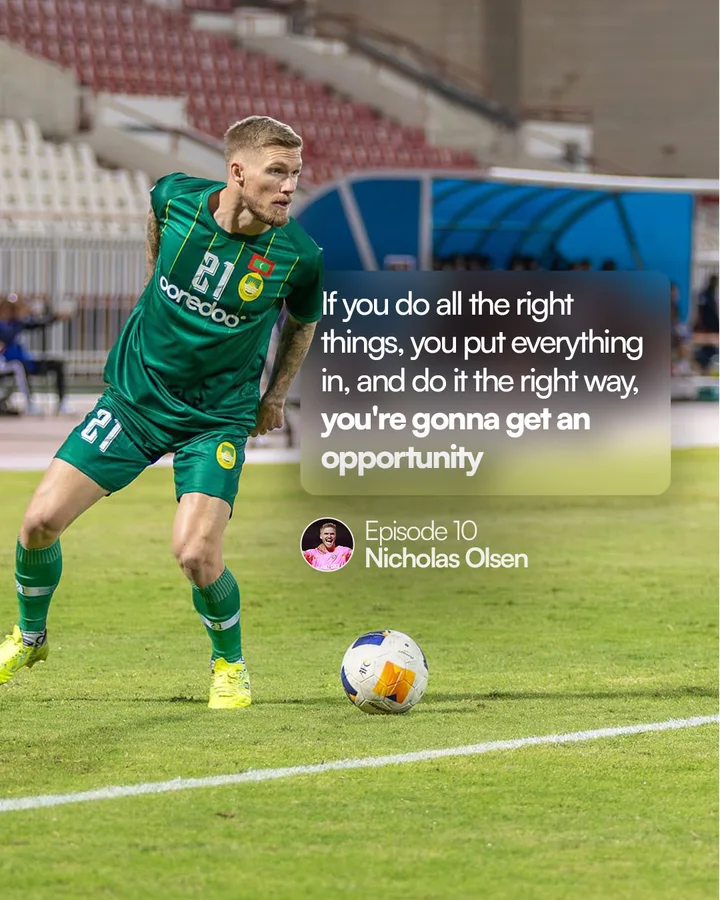
59:35 Nicholas Olsen I gotta make sure that I'm recovered and ready. And at the time you feel embarrassed and you feel like they're going out and they're having fun and and this and that and it's like but then deep down you're like, Well, that's what's gonna make the difference At the end of the day, if you do all the right things and you put everything in and do it the right way, you're gonna get an opportunity.
59:52 Jan Yeah, I think that's a very good summary of all the learnings that you took of your story. To finish up the episode, I always like to ask a few different questions that are a more light, a easier to answer. You already gave us a few ideas, but what would you say is the most unexpected place that football has taken you?
60:17 Nicholas Olsen probably are the quay, obvious no, actually, the the Maldives The Maldives does was so unfortunate.
60:23 Jan Like a particular spot, a particular stadium, what is it that you're like, oh my God, this memory comes to mind. It's like, wow, that was weird. That was random. That was amazing.
60:33 Nicholas Olsen Yeah, probably the the Maldives is like one of the smallest islands in the world and I I've I've I've got there and I'm like the I was just thought it was known for just beach resorts and and that sort of thing and just out of nowhere in the middle of their city which is so squashed together there's just a stadium. And I was like this is so random but this is so cool at the same time.
60:52 Jan So one of the best stadiums you played in?
60:57 Nicholas Olsen The best stadiums would have to be Amy Park's up there. it was the best stadium, probably one of the best stadium I played in, but it was also the most most nerve wracking because it's feels I don't know, it feels like everyone's on top of you.
61:10 Jan Yeah, fair enough. If there's one moment in your career and you would be able to relive it, which one would it be?
61:19 Nicholas Olsen when I signed in Vietnam.
61:23 Jan Bye.
61:24 Nicholas Olsen I just thought it was the weirdest, coolest things. The club was pink and I was like, what is this is so random. It was the most random thing, just going to Vietnam and having to trial and stuff. But when I signed that contract there, that was one of the best moments.
61:40 Jan Okay, good. I usually with this question now, I go a little bit like into the younger ages. But for you particular, I'm gonna say 16 years old because that was the age group where you had to, or the change from one to the second around that time, you have to figure out things. So if you think back that 16 year old you, What would he say to you now looking at what you've done since that moment, until now in terms of your career? What would that 16 year old say to you?
62:12 Nicholas Olsen Probably say, Well done. It paid off. Yeah.
62:16 Jan Yeah, and would do everything exactly again.
62:19 Nicholas Olsen Yeah, hundred percent, yeah. Yeah. I don't think
62:21 Jan Love it.
62:21 Nicholas Olsen I I love the career I had, I love the places I went to, I wouldn't I wouldn't change it for anything.
62:28 Jan Okay, last two. Who was the best player that you ever played against and why?
62:35 Nicholas Olsen Carlos Tevez.
62:37 Jan Really, where?
62:38 Nicholas Olsen We're in China. So when I was at Sydney United, we did the pre season just pre game in in China. We went there and we played against Shanghai Shenhua. And Carlos Teves came on in the sixtieth minute and you just couldn't touch the guy. Absolute bulldog. like they called him the bulldog and it was just unbelievable. The guy was like obviously coming to the end of his career, but he was just so quick off the mark, so powerful. Was yeah, was amazing to see in person.
63:02 Jan So were you in that moment being like, okay, now I can see when he was younger, that would have been the difference, the level. Yeah.
63:06 Nicholas Olsen Nah, next level. you just when you see that you're just like, man, there's levels. there's levels to the top, top players.
63:15 Jan Yeah, 100%. That's an amazing story. And you know what? You would have never experienced that if you have not followed through.
63:21 Nicholas Olsen Exactly. Yeah.
63:23 Jan Last one, that's a new one. Let's see what answer you give me and maybe the next guests are gonna come on. What is one thing you wish you would change in football in Australia?
63:33 Nicholas Olsen make a more simple pathway. Make it make it easier
63:36 Jan Okay.
63:36 Nicholas Olsen for people to navigate. Yeah. And just yeah, not making people have to go to all different places. if you want to go just a simple pathway, that would be that would be the best way.
63:47 Jan Okay, I think that's a good dream. That's a good wish. Hopefully it will happen over the next years. I know that both of us
63:50 Nicholas Olsen Yes. More of a dream.
63:56 Jan working as coaches as well, will try to at least help navigate it, maybe improve it over the next years, who knows. For now, Nick, I wish you good luck for the rest of the season. I know you guys
64:07 Nicholas Olsen Yep, you too, thank you.
64:08 Jan had... At Sharks, you guys have big aspirations for the next year. So, yeah, we'll definitely keep following your journey. thanks a lot for coming on. if anyone
64:16 Nicholas Olsen Yeah, thank you so much.
64:17 Jan that is based in the southern area of Sydney,
64:20 Nicholas Olsen Enjoying a lot.
64:21 Jan reach out to Nick if you need any additional training. He does a great job over there. I've seen him on the pitch. yeah, until then, enjoy the rest of the season. And then hopefully this time end of the year, you actually get to have a proper break and a proper vacation.
64:33 Nicholas Olsen Yeah. First time in a while. Would be nice.
64:36 Jan Yeah. Thanks a lot, Nick. Enjoy and good luck for the weekend. Ciao.
64:38 Nicholas Olsen Perfect. Thanks, man. Cheers, thank you.